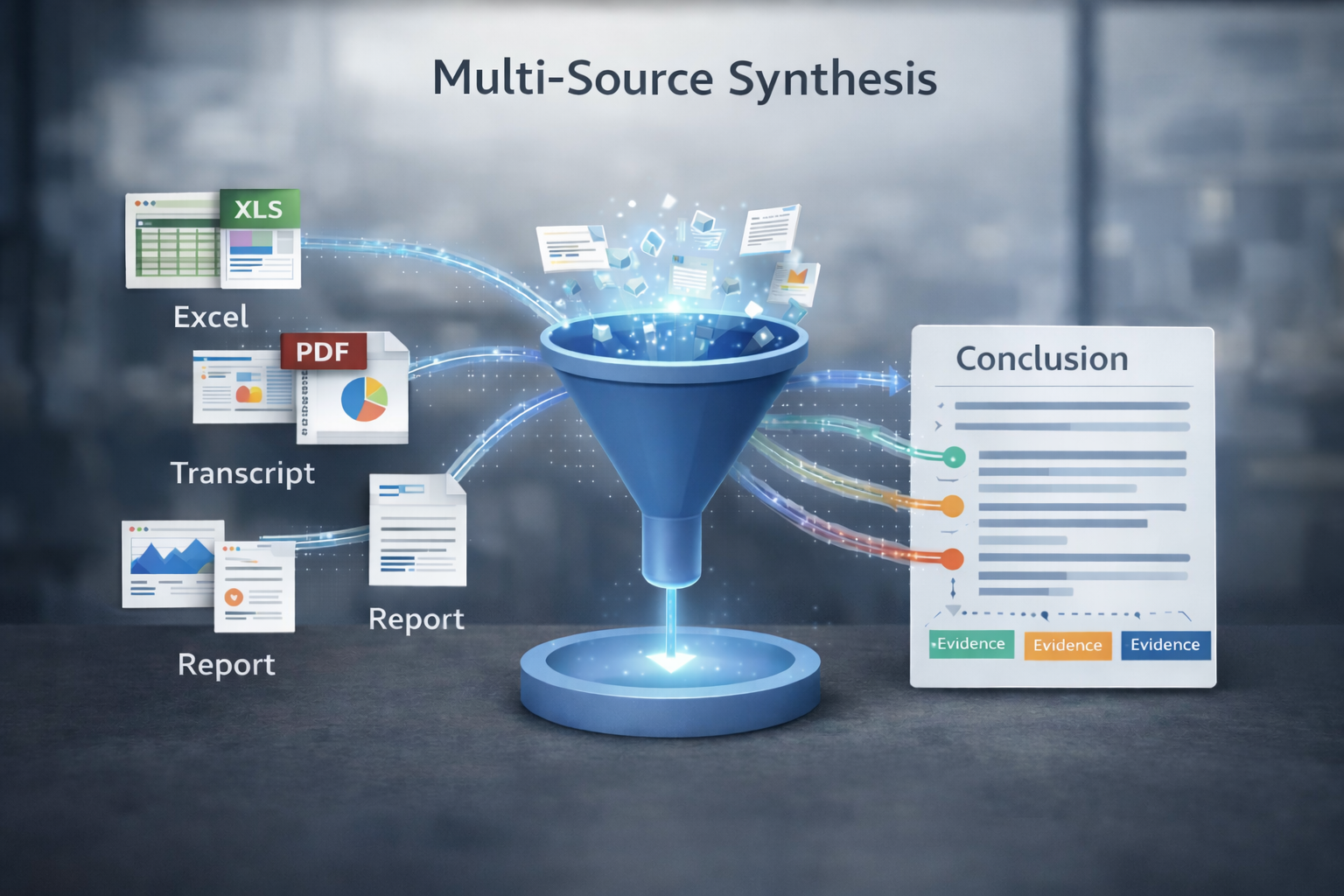
The Synthesis Problem
Every serious consulting engagement hits the same wall.
You have the data. The industry reports. The financial models. The earnings transcripts. The internal strategy documents. The market research.
The problem isn't information scarcity. It's the opposite: you have too many sources saying different things in different formats with different methodologies, and someone needs to make sense of all of it before Thursday.
That's synthesis. And it's the hardest part of consulting work.
Why Synthesis Is Where Value Lives
Research is necessary. Analysis is important. But synthesis is where the actual insight happens.
Research answers: "What do we know?" Analysis answers: "What does this data show?" Synthesis answers: "What does this mean, and what should we do about it?"
A partner doesn't want a summary of five reports. They want a structured point of view — informed by those five reports, reconciling their differences, identifying the implications, and surfacing the tradeoffs.
That's a fundamentally different cognitive task than reading and summarizing. It requires holding multiple conflicting frameworks in mind simultaneously and producing something coherent.
The Five Steps of Real Synthesis
Step 1: Normalize
Before you can compare sources, you need them in comparable terms.
- One report sizes the market in revenue, another in units
- One model uses calendar year, another fiscal year
- One transcript quotes growth in percentage, another in absolute dollars
- One dataset is US-only, another is global
Normalization isn't glamorous, but it's essential. You can't compare Q3 revenue to FY earnings without first aligning the basis.
Step 2: Compare
With normalized data, you can identify where sources agree and disagree.
Agreement = Higher confidence. When three independent sources converge on a market size, that estimate is defensible.
Disagreement = Signal. When sources diverge, it usually means different assumptions or methodologies. Understanding why they disagree is often more valuable than picking one number.
Step 3: Identify Patterns
Across multiple sources, patterns emerge that no single source reveals:
- Growth is accelerating in two segments but decelerating overall
- Customer acquisition costs are rising across all industry reports, but the company's internal data shows improvement
- Regulatory risk appears in every analyst report but isn't quantified consistently
These cross-source patterns are where the real insight lives.
Step 4: Structure Implications
Patterns need to be structured into implications that decision-makers can act on:
- "Market growth is segment-specific" → "We should concentrate investment in segments X and Y, not spread across the market"
- "CAC is rising industry-wide" → "Our improving CAC is a competitive advantage worth highlighting to investors"
- "Regulatory risk is real but unquantified" → "We need scenario analysis for three regulatory outcomes"
The leap from pattern to implication is where junior associates struggle and senior consultants add their value.
Step 5: Synthesize Conclusions
The final step produces a coherent narrative that:
- Acknowledges the data landscape (what we know, what we don't)
- Presents a structured point of view (what we believe and why)
- Identifies tradeoffs (what's gained and lost with each option)
- Recommends a path forward (what to do next)
This is the board-ready conclusion. Not a data dump. Not a summary. A synthesized point of view backed by evidence.
Why Traditional Workflows Break Down
The Tab Problem
A typical synthesis task involves 8-15 open documents, each in a different format. The analyst switches between them constantly, maintaining the mental model in their head. One interruption and the thread is lost.
The Version Problem
Synthesis happens over days or weeks. During that time, new data arrives, assumptions change, and the analysis evolves. Keeping the synthesis current while the inputs change is operationally brutal.
The Handoff Problem
The analyst who did the synthesis hands the structured findings to the person building the deliverable. Context is lost in translation. The deliverable producer doesn't understand why certain conclusions were reached, leading to either blind replication or uninformed editing.
The Iteration Problem
The partner reviews the synthesis and wants three changes: different assumption on growth rate, include the competitor analysis, and reframe for a different audience. Each change requires partially rebuilding the synthesis from scratch.
What Good Synthesis Infrastructure Enables
The best synthesis workflows share characteristics:
Multi-format ingestion. Excel models, PDF reports, Word documents, transcripts, raw data — agents ingest everything into the same analytical environment without manual reformatting.
Cross-source analysis. Agents answer questions across all documents simultaneously. "What do all three reports say about market growth?" instead of reading each one separately.
Pattern surfacing. Agents identify where sources agree, disagree, and what patterns emerge across the dataset.
Structured output. Synthesis produces organized conclusions — not a pile of notes — that flow directly into deliverables with the reasoning intact.
Iterability. When assumptions change, the synthesis updates. When new data arrives, it integrates. Without starting over.
The Synthesis-to-Deliverable Pipeline
When synthesis is done well, the deliverable almost writes itself. The conclusions are structured. The evidence is cited. The logic flow is clear. The hard work — the actual thinking — is already done.
The deliverable becomes what it should be: the artifact that communicates the synthesis. Not the place where the synthesis happens for the first time.
The Bottom Line
The consulting firms that build agentic synthesis capability — real multi-source, multi-format, iterative synthesis powered by AI agents — will produce better work in less time.
Not because they have better people. But because their people spend time on the thinking instead of the logistics of handling data.
Synthesis is the work. Everything else is just moving information around.
Synthesize Across Any Source. In One Flow.
Upload Excel, PDFs, transcripts, and raw data. Get structured synthesis with cross-source patterns and board-ready conclusions.
Get Started Free