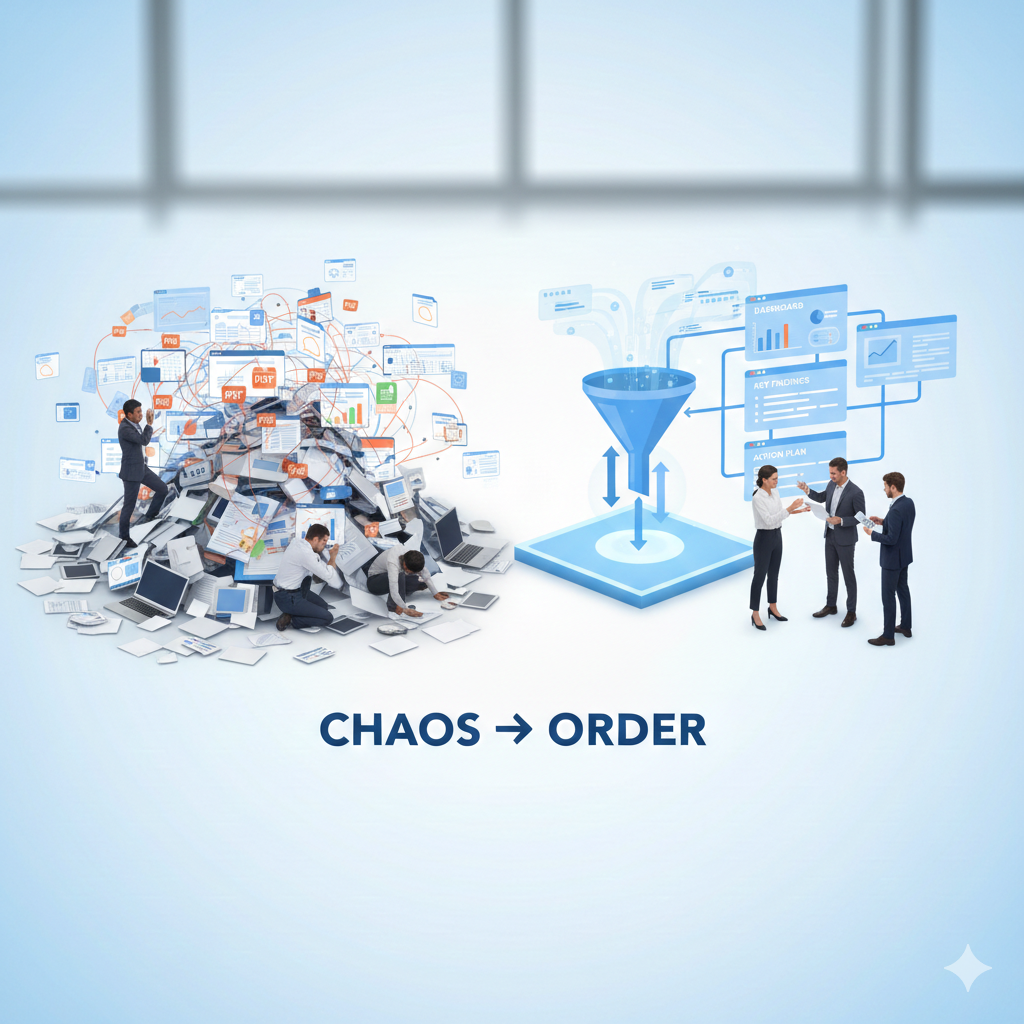
The Speed That Changes Everything
Consulting has a speed problem. Not in billing — firms are fast at that. In iteration.
A typical revision cycle on a strategy engagement: Partner reviews the deliverable Friday afternoon. Sends comments. Associates rework over the weekend. Updated version Monday morning. Partner reviews again. Another round of changes. Updated version Wednesday.
One cycle: 5 days. Three cycles (typical): 15 days. On a 6-week engagement, that's nearly half the timeline spent on iteration, not creation.
What if each cycle took 30 minutes instead of 5 days?
Why Iteration Speed Matters More Than Creation Speed
Every consulting methodology recognizes that work improves through iteration. The Pyramid Principle assumes you'll refine your argument. MECE requires checking and re-checking your logic. Consulting frameworks are built for multiple passes.
But the operational reality works against this. When each iteration costs days, teams limit iterations. They ship V2 when V5 would have been better. They accept "good enough" because "great" would require another week.
Fast creation with slow iteration produces mediocre work.
Moderate creation with fast iteration produces excellent work.
This is counterintuitive. Teams optimize for faster first drafts when they should optimize for faster revisions.
The Three Types of Iteration
1. Assumption Iteration
The partner says: "What if we assume 8% growth instead of 12%?"
Traditional workflow: Analyst reopens the financial model. Changes the assumption. Recalculates downstream effects. Updates the charts. Rewrites the narrative sections that referenced the old numbers. Reformats affected slides. Reviews for consistency. Time: 4-8 hours.
Agentic workflow: Change the assumption. Agents recalculate the analysis, update the synthesis, and regenerate the output. The analyst reviews the changes. Time: 15-30 minutes.
Assumption iteration is the most common and most expensive type. Every strategy engagement involves multiple rounds of "what if we change this number?"
2. Scope Iteration
The client says: "We'd like to include the European market in the analysis."
Traditional workflow: New research required. New data gathering. Extended analysis. Additional synthesis. New sections in the deliverable. Cross-checking against existing content. Time: 3-5 days.
Agentic workflow: Upload European data sources. Agents integrate the new data, extend the analysis, update the synthesis with cross-market patterns, and regenerate the output with the expanded scope. Time: 2-4 hours of review.
Scope changes are the deadliest iteration type because they cascade through every layer of the work.
3. Audience Iteration
The engagement manager says: "We also need a version for the operating committee, not just the board."
Traditional workflow: Restructure the narrative. Change the level of detail. Adjust the framing from strategic to operational. Rebuild relevant sections. Time: 1-2 days.
Agentic workflow: Reframe for the new audience. Agents adjust the structure — more operational detail, different emphasis, same underlying research and analysis. Time: 30-60 minutes.
Same substance, different packaging. In a disconnected workflow, this is nearly a full rebuild. In an integrated workflow, it's a reframe.
What Fast Iteration Enables
Working Sessions That Actually Work
The most powerful moment in consulting is the live working session. Senior client and consulting team in the same room, working through the analysis together.
With slow iteration, working sessions are limited to discussing the work and noting changes for later. "We'll update that and send a new version."
With fast iteration, working sessions become productive creation sessions. "Let me change that assumption — here's what the analysis looks like now." Real-time exploration. Decisions made in the meeting, not deferred to the next cycle.
Higher Quality Through More Passes
When iteration is cheap, you iterate more. And more iteration means higher quality.
- V1 gets the structure right
- V2 sharpens the argument
- V3 challenges the assumptions
- V4 adds the edge cases
- V5 is the version that survives board scrutiny
Most teams stop at V2 because V3-V5 would cost too much time. When iteration is fast, V5 is routine.
Exploration That Wouldn't Otherwise Happen
"What would this look like with a different competitive frame?" "Can we run a sensitivity on three regulatory scenarios?" "What if we sized the opportunity bottom-up instead of top-down?"
These questions go unasked when each one costs a day of work. They get explored when each one costs fifteen minutes.
The best strategic insight often comes from the fourth angle you explore, not the first. Fast iteration makes exploration affordable.
Client Responsiveness
"Can you have an updated version for our 3pm meeting?"
With traditional workflows: probably not. With fast iteration: easily.
Client responsiveness builds trust. It signals that the consulting team is engaged, capable, and in control. It turns "we'll get back to you" into "here it is."
The Compounding Effect
Iteration speed compounds across an engagement:
Week 1: Research and first draft arrive 3 days earlier because the production cycle is compressed.
Week 2: The client's first-round feedback is incorporated same-day, not next-week. The team explores two additional strategic angles that wouldn't have been feasible.
Week 3: Working sessions produce real-time output. The team iterates through three assumption scenarios in one meeting.
Week 4: The final deliverable has been through seven iterations, not three. The quality difference is visible.
By the end of the engagement, the team that iterates fast has produced fundamentally better work — not because they're smarter, but because they had more cycles to refine.
The Offshore Comparison
Many firms outsource deliverable production to offshore teams. The economics are compelling: lower cost per hour.
But the iteration speed is brutal. Send the brief Monday. Get first draft Wednesday (at best). Send revisions. Get V2 Friday. One iteration cycle per week if you're lucky.
Fast onshore iteration beats slow offshore production every time. Not because the work quality differs at the task level, but because the iteration cycle is 100x faster.
Ten iterations in the time it takes to outsource once.
The Bottom Line
The consulting firms that win the next decade won't be the ones with the most associates. They'll be the ones with agentic AI that delivers the fastest iteration cycles.
Fast iteration means more exploration, higher quality, better client responsiveness, and working sessions that produce output in real time.
The heavy lifting, handled. The iteration, instant.
Iterate in Minutes, Not Days
Research, analyze, synthesize, and produce client-ready output — then iterate as many times as you need. Ten revisions in the time it takes to outsource once.
Get Started Free