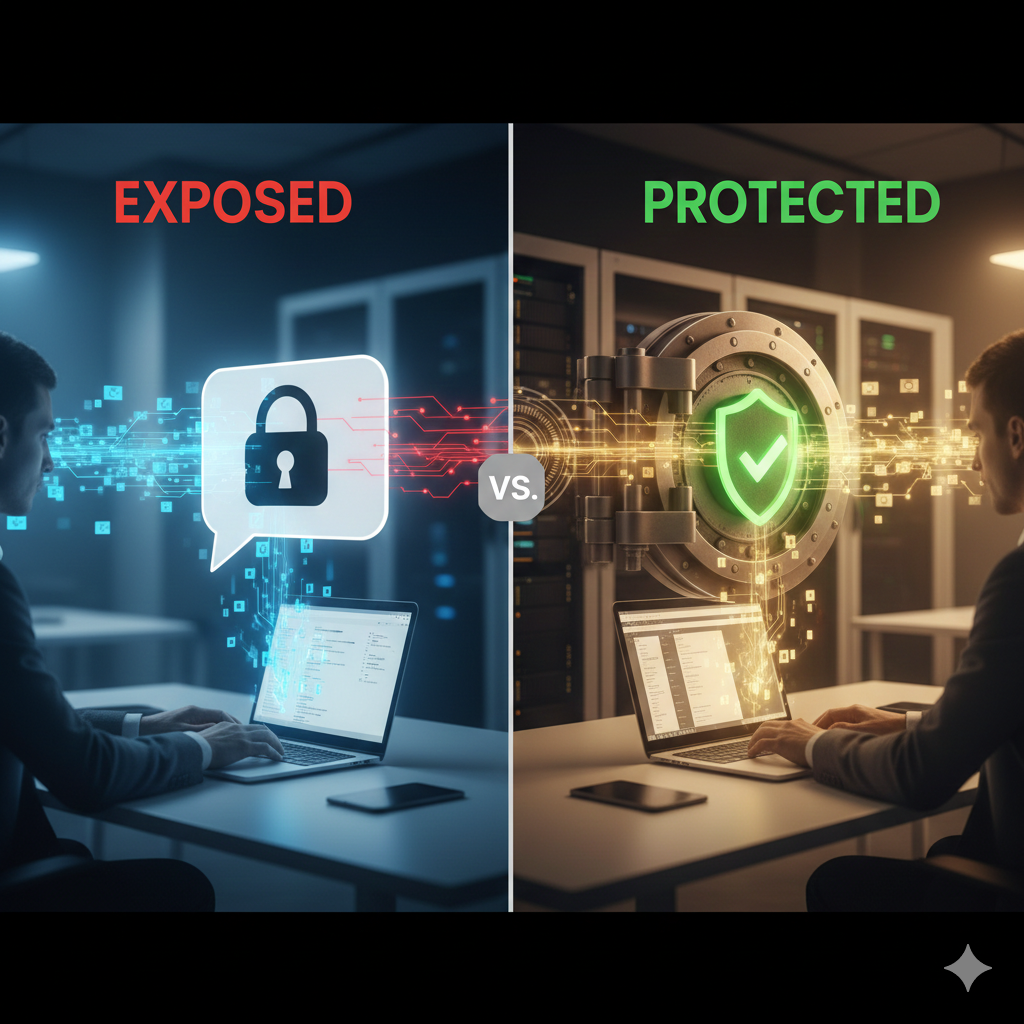
The New "Reply All"
Every consulting firm has a horror story about an accidental email. A client name sent to the wrong person. A financial model attached to the wrong thread. A confidential deal name visible in a screenshot.
Those mistakes are obvious. The new one is invisible.
Every time a consultant pastes client data into a consumer AI chatbot, that data leaves the building. The client name, the deal structure, the financial projections, the competitive intelligence — all of it transmitted to a third-party AI provider with terms of service that most consultants have never read.
This is happening at every firm. Every day. And most compliance teams don't even know.
What Actually Happens to Your Data
When you use a consumer AI tool, here's the typical data flow:
You type or paste: Client financials, deal names, strategy documents, board materials.
The AI provider receives: Your full input, including any client-confidential information.
What happens next varies by provider:
- Some providers use your data to improve their models (training)
- Some providers retain your data for a defined period
- Some providers share data with subprocessors
- Most providers log your conversations for safety monitoring
Even providers that claim "we don't train on your data" typically still transmit, process, and temporarily store your inputs on their infrastructure. The data leaves your control.
The NDA Problem
Most consulting engagements operate under Non-Disclosure Agreements. The typical NDA prohibits sharing confidential information with third parties without explicit consent.
Here's the question most firms haven't asked: Does pasting client data into a consumer AI tool constitute sharing with a third party?
The answer, for most legal teams reviewing this carefully, is yes.
When a consultant inputs "Project Falcon — $2.4B acquisition of TargetCo by AcquirerCo, expected close Q3" into a consumer AI chatbot, they've shared the deal name, the parties, the valuation, and the timeline with a third-party AI provider. That's a third-party disclosure.
Most clients would not be comfortable knowing their confidential deal details live on a consumer AI provider's servers — even temporarily.
The Training Risk
Some AI providers use customer inputs to improve their models. This means your client's proprietary data could theoretically influence the model's responses to other users.
Even providers that don't train on enterprise data may train on consumer-tier data. If your team uses personal accounts for work tasks — and many do — the protection disappears.
The risk isn't theoretical. Samsung banned consumer AI chatbots after engineers accidentally leaked proprietary semiconductor data. JPMorgan restricted access after compliance concerns. The pattern is consistent across industries.
What "NDA-Safe AI" Actually Means
Not all AI infrastructure is created equal. Here's what to look for:
Private, Isolated Infrastructure
The AI processes your data on dedicated infrastructure that's separate from consumer-facing platforms. Your inputs never comingle with other customers' data. No shared inference endpoints.
No Third-Party AI Transmission
Your data is processed on private, isolated infrastructure — never routed through consumer AI platforms. The infrastructure you chose is the only one that ever sees your data.
Zero Training on Customer Data
Not "we don't train on enterprise data." Not "you can opt out." Zero. No AI model is ever trained, fine-tuned, or improved using your inputs — full stop.
Data Processing, Not Storage
Your inputs are processed to generate the output you requested, then discarded. No conversation logs retained by the AI layer. No data persistence beyond what's needed for the immediate task.
Auditable Data Flow
You can trace exactly where your data goes, who processes it, and when it's deleted. Useful for compliance teams, auditors, and clients who ask the right questions.
The Compliance Conversation
If you're at a firm that uses AI tools — and every firm does — here are the questions your compliance team should be asking:
-
Which AI tools are employees using? Not just approved tools. The actual tools. Shadow IT is rampant with AI.
-
Where does the data go? Trace the full data flow from input to processing to storage to deletion.
-
Do our NDAs allow this? Review standard client NDAs against the data practices of your AI providers.
-
What's our exposure? If a client discovered their confidential data was processed by a consumer AI tool, what's the liability?
-
What's the alternative? You can't ban AI — your competitors won't. The answer is infrastructure that's NDA-safe by design.
The Competitive Angle
Here's the part most firms miss: AI security isn't just risk mitigation. It's a competitive advantage.
When you can tell a client, "Our AI infrastructure is completely isolated. Your data never touches consumer AI chatbots. We're confidential by design" — that's a differentiator.
It's the same dynamic that drove cloud security adoption. The firms that moved first and built secure practices won client trust. The firms that waited had to explain why they weren't there yet.
AI confidentiality is the same conversation. The firms that solve it now position themselves as the trusted partner.
The Bottom Line
The question isn't whether consulting firms should use AI. They must. The question is whether they'll use AI that respects the confidentiality their clients expect.
Pasting client data into consumer AI is the new "Reply All." The damage is real. The solution exists. The firms that act first will be the ones their clients trust most.
NDA-Safe AI. Private Infrastructure.
Your data never touches consumer AI chatbots. Research, analyze, and synthesize — with complete confidentiality.
Get Started Free