The Artifact Problem
The consulting industry has spent the last decade optimizing the wrong thing.
Slide design tools. Template libraries. Formatting assistants. Beautiful fonts. Animated transitions. The entire ecosystem has been focused on making the output look better.
But here's what clients actually pay for: the work behind the output.
When a Fortune 500 board reviews a strategy recommendation, they're not evaluating the slide design. They're evaluating the quality of the research, the rigor of the analysis, the soundness of the synthesis, and the defensibility of the recommendation.
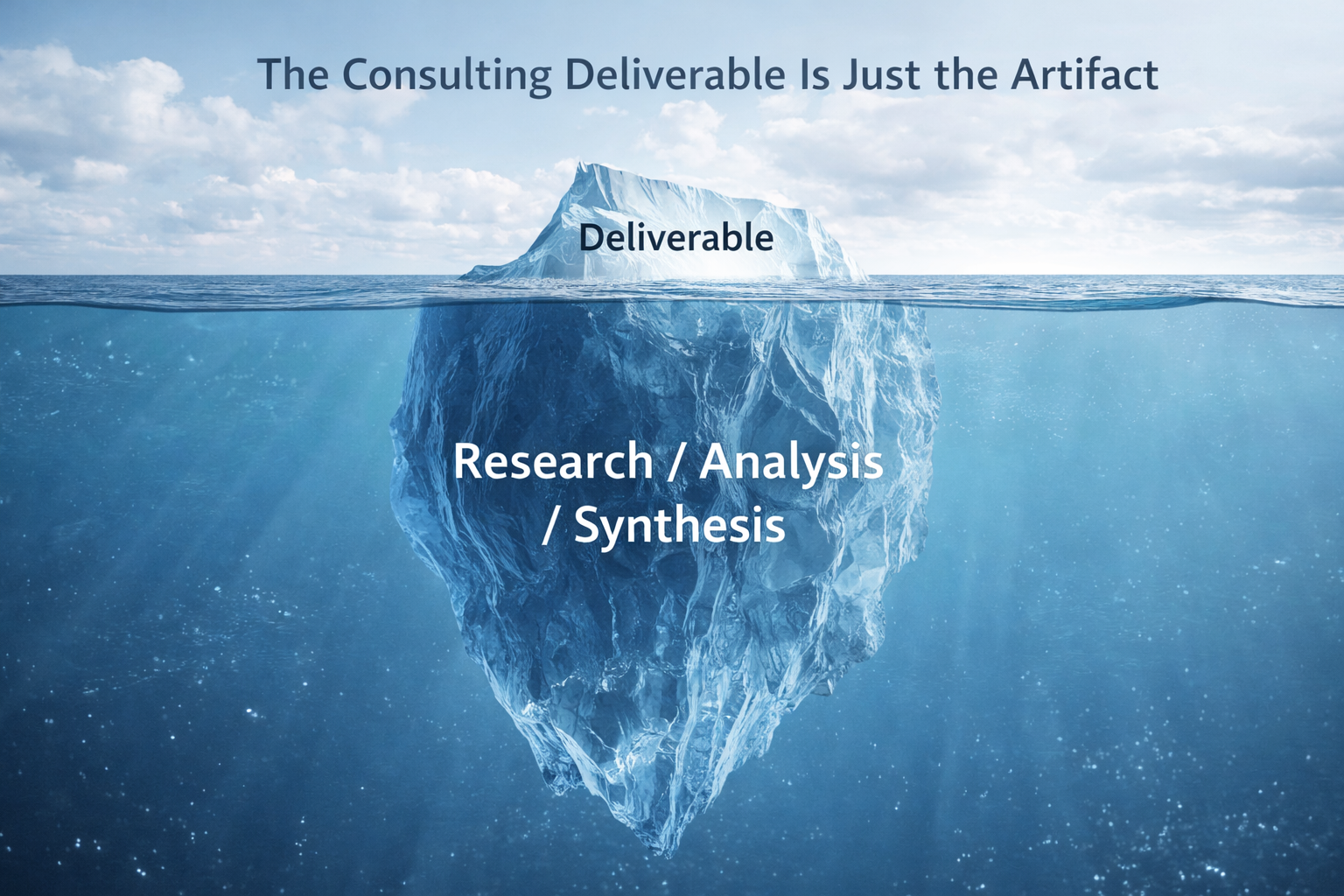
The deliverable is just the artifact. The value is the thinking.
What Clients Actually Buy
Break down any consulting engagement and the value chain is clear:
Research — Finding accurate, credible information. Building a factual foundation from industry data, financial reports, competitive intelligence, and expert perspectives.
Analysis — Processing that information. Identifying patterns, quantifying impacts, modeling scenarios, stress-testing assumptions.
Synthesis — Making sense of the analysis. Reconciling conflicting data, structuring implications, identifying tradeoffs, forming a point of view.
Recommendation — The strategic judgment. What to do, why, and what it will cost.
Deliverable — The artifact that communicates all of the above.
The deliverable is step 5 of 5. It's the container. The value lives in steps 1 through 4.
The Tools Got It Backwards
Look at the AI tools that emerged in 2023-2024 for "consulting" and "presentations":
- Gamma: generates slides from prompts
- Tome: AI-powered slide creation
- Beautiful.ai: smart design templates
- Dozens of "AI presentation makers"
Every one of them starts at step 5. They help you make the artifact. None of them help with the research, analysis, or synthesis that makes the artifact worth reading.
It's like giving a surgeon a beautiful scalpel but no diagnostic tools. The instrument looks great. But the diagnosis — the actual medical thinking — still requires separate infrastructure.
Why This Matters
The Quality Gap
When the deliverable is produced separately from the research and analysis, quality degrades:
- Data points lose their citations somewhere between the research spreadsheet and the final slide
- Analytical nuance gets simplified during the "make it look good" phase
- Synthesis conclusions get disconnected from their supporting evidence
- The person building the deliverable doesn't fully understand the analysis behind it
The handoff from thinking to formatting introduces errors, oversimplifications, and context loss.
The Iteration Tax
When a partner says "change the growth assumption from 12% to 8%," what actually needs to happen?
In a disconnected workflow: rebuild the analysis, re-synthesize the conclusions, rebuild the deliverable. Each step manual.
In an integrated workflow: change the assumption, let the analysis flow through, let the synthesis update, let the output regenerate. Each step connected.
The difference between "that'll take two days" and "give me ten minutes."
The Defensibility Problem
A board member asks: "Where did this market sizing come from?"
In a disconnected workflow: the presenter checks their notes, hopes they remember which source supported which number, and gives a directionally correct answer.
In an integrated workflow: the research is embedded in the output. The citation is right there. The methodology is traceable. The answer is immediate and specific.
What an Integrated Workflow Looks Like
The future of consulting work isn't better slide tools. It's agentic workflows where AI agents handle research, analysis, synthesis, and output production as one continuous process:
Drop your files. Industry reports, financial models, earnings transcripts, internal data — in whatever format they arrive.
Research and analyze. Our agents find additional credible sources, extract data across formats, identify patterns, and build defensible estimates.
Synthesize. Agents compare across sources, identify patterns, structure implications, and analyze tradeoffs — all connected to the underlying data.
Produce output. Client-ready deliverables built on the research and analysis — not separate from it. Every conclusion traceable to its source.
Iterate. Change an assumption and agents update the entire chain. New data? They integrate it. Different audience? The framing adjusts.
This isn't a slide tool with research bolted on. It's a research and analysis tool with deliverable production built in.
The Shift Already Happening
The firms that get this are already moving:
PE firms are investing in tools that connect CIM analysis directly to IC memo production — because the analysis is the value, not the memo format.
Strategy boutiques are building workflows that maintain the research-to-output chain — because defensibility matters more than design.
Internal strategy teams are choosing integrated platforms over slide tools — because their executives ask "how did you get this number?" not "can you make this slide prettier?"
The market is bifurcating. On one side: tools for making artifacts. On the other: tools for doing the work.
The Bottom Line
The consulting deliverable is not the product. It's the packaging.
The product is the research. The analysis. The synthesis. The strategic judgment.
The firms that invest in the work — and treat the deliverable as the natural output of that work — will produce better, faster, more defensible results.
Stop optimizing the artifact. Start investing in the work.
The Work, Not Just the Output
Research, analysis, synthesis, and client-ready output — all in one integrated flow. The deliverable is just the last step.
Get Started Free