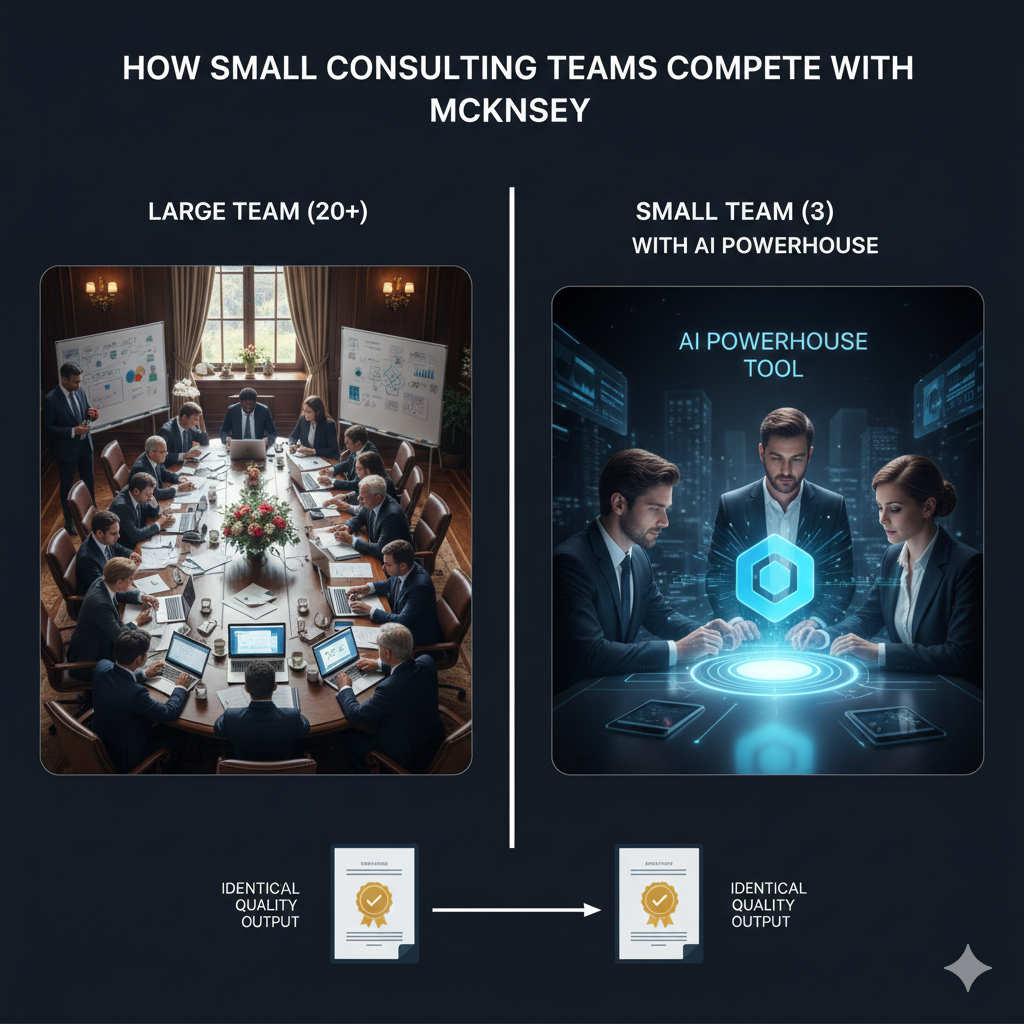
The Leverage Gap
A McKinsey engagement team for a typical strategy project includes 4-6 associates, 1-2 engagement managers, and a partner. Behind them sits a research department, a knowledge center, and a visual communications team.
A boutique consulting firm fields 2-3 people for the same scope. Same client expectations. Same board deadline. A fraction of the resources.
This leverage gap has defined the consulting industry for decades. Large firms win because they can throw bodies at the problem. Boutiques compete on expertise and relationships — but they can't match the sheer research and production capacity of a team of twenty.
Until now.
What the Large Firms Actually Do
Strip away the brand and the billing rates, and large consulting firms produce their work through a fairly standard process:
Week 1-2: Research and data gathering
- Associates scour industry reports, financial databases, and expert networks
- Research teams pull relevant case studies and benchmarks
- Data analysts clean and structure raw data
Week 2-3: Analysis and synthesis
- Associates build analytical frameworks
- Engagement managers structure the narrative
- Multiple rounds of internal review and iteration
Week 3-4: Deliverable production
- Associates build the output
- Visual communications team polishes formatting
- Partner reviews and provides direction
The intellectual content — the actual strategic thinking — happens in weeks 2-3. Everything else is logistics, data handling, and production.
Where the Opportunity Lives
Here's the insight that changes the game for small teams: most of what large firms do with headcount is work that's now automatable.
Research and data gathering? That's pattern matching across sources, citation tracking, and data extraction from documents. AI agents do this well.
Data normalization and structuring? That's format conversion, unit alignment, and cross-reference checking. AI agents do this perfectly.
Deliverable production? That's applying structure, formatting, and visualization to organized content. AI agents do this fast.
What machines can't do — and what small teams have always been better at — is the strategic thinking. The synthesis. The client relationship. The judgment call. The boardroom presence.
The leverage gap was never about intelligence. It was about the logistics around intelligence. And agentic AI now handles those logistics.
The New Small Team Playbook
Research: Go Deeper, Faster
A 3-person team used to choose between breadth and depth in research. Cover the full landscape superficially, or go deep on one angle?
With agentic research infrastructure, small teams can do both. Agents ingest all available sources — industry reports, financial data, earnings transcripts, news — and extract relevant information systematically. Every data point cited. Every source tracked.
The partner at the client meeting asks "Did you look at the regulatory angle?" and the answer is yes, with three sources and a structured summary — not because someone spent three days on it, but because the research infrastructure covered it systematically.
Synthesis: Multiple Perspectives, One Team
Large firms use multiple associates to bring different analytical perspectives. One looks at the market from the supply side, another from demand, a third from regulatory. They synthesize in working sessions.
Small teams can achieve the same multi-perspective synthesis by working across their entire document set simultaneously. Compare what the financial model says with what the industry reports show with what the earnings transcripts reveal. Surface the patterns. Identify the contradictions. Structure the implications.
The thinking is the same. The logistics are faster.
Iteration: Move at Client Speed
Large firm advantage: when the partner wants changes, they distribute the work across multiple associates. Parallel processing via headcount.
Small team with good infrastructure: when the partner wants changes, they regenerate the affected sections while keeping the rest intact. Iterate in minutes instead of days.
This changes the client dynamic fundamentally. Instead of "we'll have the revised version Monday," it's "let me regenerate that section — give me ten minutes."
Output: Consulting-Grade Without the Army
The visual communications team at a large firm does one thing: make the output look professional. Consistent formatting, clean charts, proper layouts.
With the right tools, small teams produce output that's indistinguishable from what a 20-person team would deliver. Brand templates applied automatically. Charts generated from data. Structured narratives with proper hierarchy.
The client sees the quality of the output. They don't see the team size behind it.
The Economics
Here's what changes when small teams compete at large-firm quality:
Pricing flexibility. Without the overhead of a large team, boutiques can price competitively — or maintain premium pricing with higher margins.
Speed advantage. A 3-person team that iterates in real-time beats a 15-person team that needs a week for each revision cycle.
Client intimacy. Senior people do the actual work. The client works with the person who understands the strategy, not an associate who's managing a process.
Scalability. Take on more engagements without proportionally growing headcount. Each team member has dramatically more leverage.
What This Doesn't Replace
Let's be clear about what technology doesn't change:
Strategic judgment. The recommendation still needs human insight, industry knowledge, and political awareness.
Client relationships. Trust is built between people, not between people and tools.
Boardroom presence. Delivering findings to a board requires human credibility and adaptability.
Creative problem framing. Identifying the right question to ask is still a human skill.
The tools handle the heavy lifting. The humans do the thinking. That's the model.
The Bottom Line
The consulting industry's leverage gap is closing. Small teams with the right infrastructure can produce research, analysis, synthesis, and client-ready output that competes with what used to require twenty people and a month of lead time.
The winners won't be firms that replace their people with tools. They'll be firms that give their best people dramatically more leverage.
You and your team. Dramatically more powerful.
Your Consulting-Grade Powerhouse
Research, analysis, synthesis, and client-ready output — all in one flow. Make your team dramatically more powerful.
Get Started Free