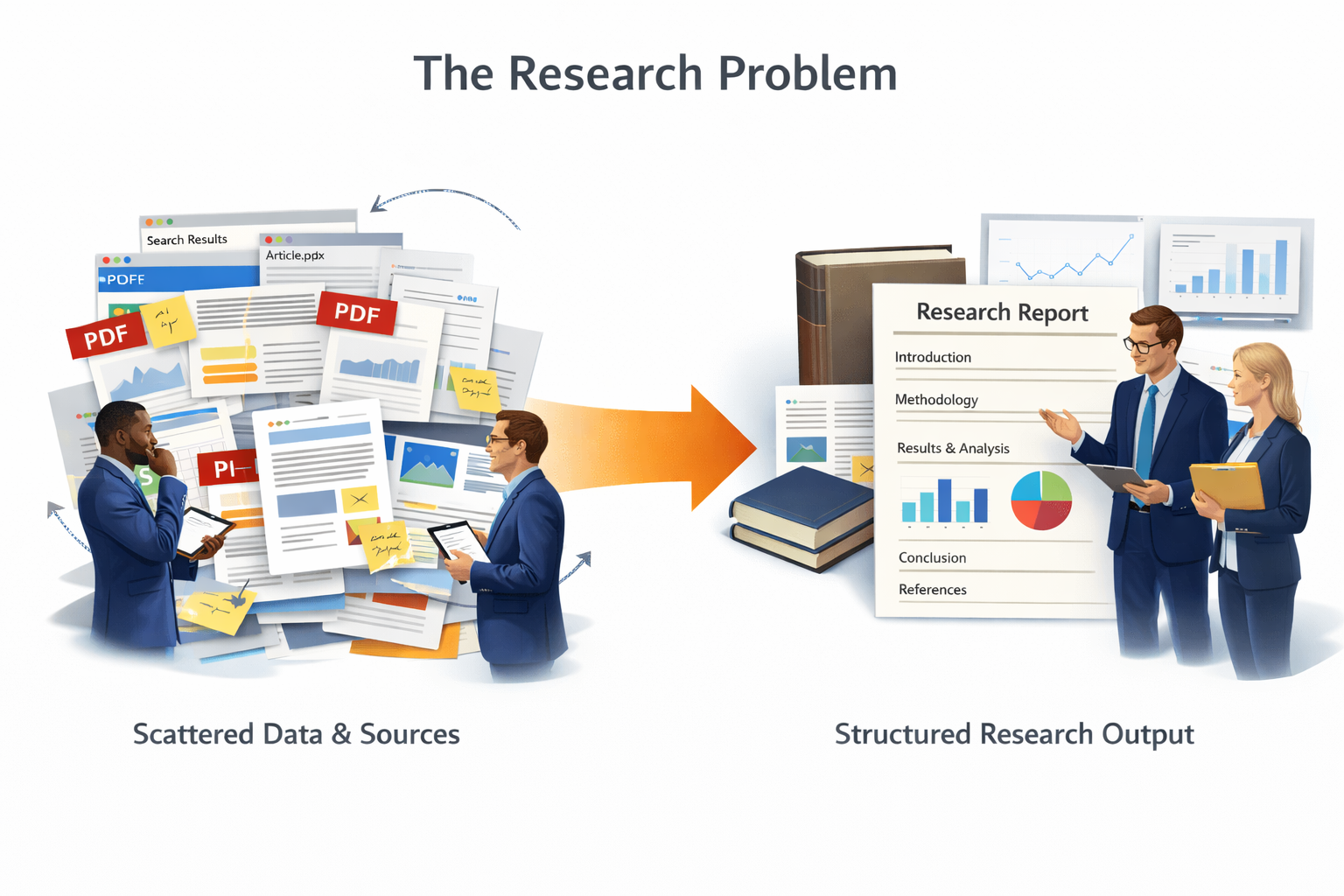
The Dirty Secret of Consulting Research
Here's what nobody says out loud: most consulting research is held together with duct tape.
A partner asks for a market sizing. An associate opens fifteen browser tabs, pulls numbers from three industry reports, cross-references with government data, and builds a spreadsheet that sort of ties together. The sources are credible enough. The logic is defensible enough. It ships.
But nobody feels great about it.
The problem isn't intelligence or effort. The problem is that the research workflow hasn't fundamentally changed in twenty years.
Where the Time Actually Goes
Research suggests that associates at major consulting firms spend 60% of their engagement time on data gathering and synthesis — the work before the work.
Here's how that typically breaks down on a strategy engagement:
Research and data gathering: 25-30% of total hours
- Searching for credible industry data
- Reading and extracting from PDF reports
- Cross-referencing multiple sources for consistency
- Building source libraries and citation trails
Synthesis and structuring: 20-25% of total hours
- Reconciling conflicting data points
- Normalizing across different formats and methodologies
- Identifying patterns across sources
- Structuring findings into coherent narratives
Deliverable production: 15-20% of total hours
- Building the actual output — the part everyone thinks takes the most time
The research and synthesis is where the real work happens. The deliverable is just the artifact.
Five Research Problems That Cost You Hours
1. The Citation Gap
You find a compelling statistic. You use it in your deliverable. The partner asks: "Where did this come from?"
You scramble. Was it the Gartner report? The McKinsey Global Institute piece? That WSJ article from three weeks ago?
Credible research isn't just finding information. It's maintaining a clean chain of custody from source to output. Most consulting teams don't have a systematic way to do this.
2. The Format Maze
Your research inputs arrive in every format imaginable: PDF annual reports, Excel models with fifty tabs, Word documents with embedded tables, earnings call transcripts, government datasets in CSV, industry reports behind paywalls.
Normalizing all of this into a consistent analytical framework is manual, tedious, and error-prone. Yet it's a prerequisite for serious analysis.
3. The Defensibility Problem
A client challenges your market sizing. "How did you get to $4.2 billion?"
The honest answer is often: "We triangulated three sources, made some assumptions, and applied a growth rate." Reasonable methodology, but there's no clean audit trail from input to output.
Defensible estimates require transparent methodology. Most research workflows make this hard.
4. The Recency Trap
You cite an industry report from 2023 in a 2025 engagement. The data is directionally correct but dated. A board member catches it. Credibility takes a hit — not because the analysis was wrong, but because the research wasn't current enough.
Keeping research current across a multi-week engagement is a real operational challenge.
5. The Gap You Don't See
Perhaps the most dangerous problem: you don't know what you don't know.
A thorough analysis should surface what's missing — gaps in the data, assumptions that need validation, areas where the evidence is thin. Most research workflows don't systematically identify these gaps. You find them when the partner asks a question you can't answer.
What Good Research Infrastructure Looks Like
The firms whose work survives partner scrutiny, client challenges, and board-level questioning share common characteristics:
Credible sourcing with citations. Every data point traces back to a named, dated, verifiable source. Not "industry sources suggest" but "Gartner, Q3 2024 Magic Quadrant, p. 42."
Multi-format ingestion. The research system handles PDFs, Excel, Word, transcripts, and raw data without manual reformatting.
Transparent methodology. Market sizings show their bottom-up and top-down approaches. Assumptions are explicit and adjustable.
Gap identification. The research process actively surfaces what's missing — data gaps, unvalidated assumptions, areas where evidence is thin.
Structured output. Research produces structured findings that flow directly into analysis and deliverables — not a pile of notes.
The Research-to-Output Pipeline
The most efficient consulting workflows treat research, analysis, and deliverable production as one continuous pipeline:
Input — Upload documents, data files, reports in any format
Research — Agents find additional information from credible sources, cite everything, build defensible estimates
Analysis — Agents normalize data across formats, compare sources, identify patterns and implications
Synthesis — Agents structure findings into coherent narratives, surface tradeoffs and recommendations
Output — Client-ready deliverables with the research baked in, not bolted on
When these steps are connected, the research quality improves because it's structured for a specific analytical purpose. And the deliverable quality improves because it's built on a defensible research foundation.
The Bottom Line
The consulting industry has a research productivity problem. The best people spend the majority of their time on work that's manual, scattered, and hard to audit.
The firms that solve this — with agentic AI that connects credible sourcing to structured analysis to client-ready output — will operate at a fundamentally different speed.
The research is the real work. Everything else is just the artifact.
Research, Analysis, and Synthesis — in One Flow
Credible sourcing, multi-format ingestion, defensible estimates, and client-ready output. See what structured research looks like.
Get Started Free