The Conversation Era Is Over
For three years, we've talked to AI. Prompted it. Coaxed it. Iterated with it. Consumer AI chatbots taught an entire profession to be better prompt engineers.
That era is ending.
The next wave isn't conversational AI. It's agentic AI — systems that don't just respond to prompts but autonomously execute multi-step workflows: research across sources, analyze data in multiple formats, synthesize conflicting information, and produce structured output ready for client review.
The difference matters for anyone who does serious analytical work.
From Answers to Deliverables
Conversational AI (2023-2024):
- You ask a question
- AI gives an answer
- You refine, re-prompt, iterate
- You assemble the final work product
- Every source, citation, and data point is your responsibility
Agentic AI (2025+):
- You provide your source documents and context
- AI researches, extracts, and cross-references
- AI applies analytical frameworks and structures the narrative
- AI delivers completed, structured output
- You review, refine, and apply strategic judgment
The shift is from assistant to autonomous agent. From "help me write this" to "here's the analysis, built from your sources, with citations."
Real Examples
Private Equity: CIM Analysis
Before: Read a 200-page CIM. Take notes across sections. Build a financial model in Excel. Write an investment memo in Word. Create an IC presentation in PowerPoint. Cross-reference everything manually. Time: 15-20 hours.
After: Upload the CIM. The system extracts financials, analyzes the business model, identifies risks, models scenarios, and produces a structured investment assessment with the CIM as the cited source throughout. Time: 3-4 hours of human review and refinement.
The human work shifts from data extraction to strategic judgment: "Is this thesis compelling? What are they not telling us?"
Strategy Consulting: Market Entry
Before: Research the market across six industry reports, three government databases, and competitor filings. Normalize the data (different methodologies, different geographies, different time periods). Synthesize into a market sizing. Build the strategic assessment. Format the deliverable. Time: 2-3 weeks.
After: Upload all source documents. The system normalizes across formats, identifies where sources agree and disagree, builds a triangulated market sizing with methodology shown, and produces the strategic assessment with every data point traced to its source. Time: 2-3 days of human review and strategic refinement.
Corporate Strategy: Quarterly Board Update
Before: Collect data from five departments. Reconcile conflicting numbers. Build charts. Write the narrative. Format for board standards. Iterate through three rounds of review. Time: 5-7 days per quarter.
After: Upload department data. The system identifies the story in the numbers — what's working, what's not, what needs decisions — and produces a structured board update with proper narrative hierarchy. Time: 1 day of review and refinement.
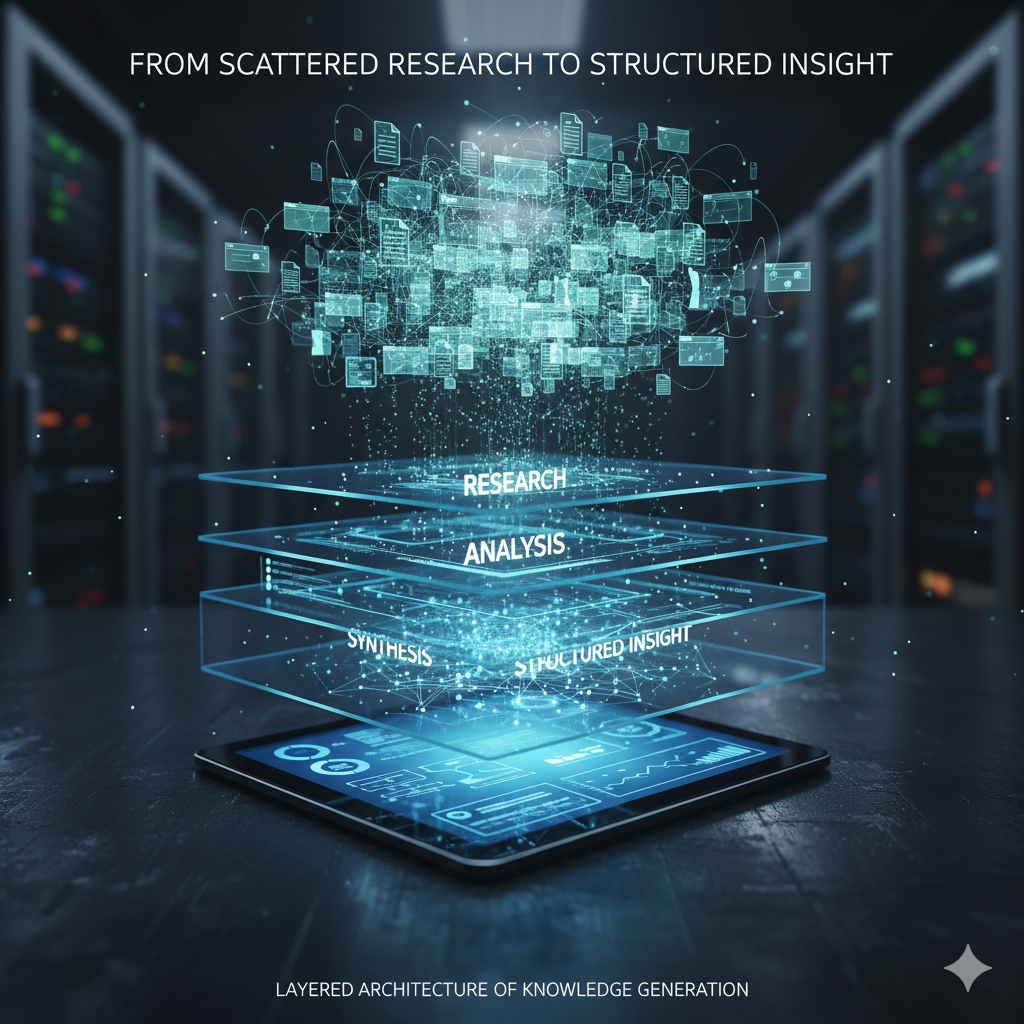
How Modern AI Workflows Actually Operate
Understanding the architecture helps you use these systems better.
Research Layer
The AI doesn't just answer questions — it actively researches:
- Extracts structured data from PDFs, Excel, Word, and transcripts
- Cross-references information across multiple sources
- Identifies credible external sources for context and benchmarks
- Maintains full citation trails from source to output
Analysis Layer
The system applies analytical frameworks:
- Normalizes data across different formats and methodologies
- Identifies patterns that span multiple sources
- Builds quantitative models from extracted data
- Flags inconsistencies and data gaps
Synthesis Layer
This is where the real intelligence happens:
- Reconciles conflicting data points across sources
- Structures implications from the analysis
- Identifies tradeoffs and decision points
- Produces a coherent narrative from fragmented inputs
Output Layer
The final deliverable is built on the preceding layers:
- Structured narrative with proper consulting hierarchy
- Data visualizations generated from the analysis
- Every conclusion traceable to its source
- Brand formatting and professional layout applied
Iteration Layer
When something changes, the chain updates:
- New assumption? The analysis adjusts, the synthesis updates, the output regenerates
- New data? It integrates into the existing analysis
- Different audience? The framing shifts while the substance stays
What This Means for Your Team
Source Documents Become Everything
AI output quality depends directly on the context you provide. The better your source documents — financial models, industry reports, internal data, transcripts — the better the work product.
This inverts the old dynamic. Previously, the deliverable was only as good as the person building it. Now, it's as good as the inputs and the human review.
Your Review Becomes Strategic
You're no longer checking whether the AI understood your prompt. You're reviewing completed analytical work against business criteria:
- Is the research accurate and well-sourced?
- Does the analysis capture the right patterns?
- Is the synthesis sound and defensible?
- Will this recommendation survive board-level scrutiny?
Higher-level review. More strategic input. Better outcomes.
Speed Becomes a Strategic Advantage
When a PE firm can analyze 3x more CIMs, they see more deals. When a consulting team iterates on a strategy in real-time during a working session, the client gets better work. When an internal strategy team produces a board update in a day instead of a week, decisions happen faster.
Speed isn't just efficiency. It changes what's possible.
Confidentiality Becomes Non-Negotiable
As AI processes more sensitive work — client financials, deal details, competitive intelligence — the security of the AI infrastructure matters more than ever.
The firms getting this right use AI that runs on private, isolated infrastructure. No data routed through consumer AI chatbots. No training on client inputs. Confidential by design.
The Practical Path Forward
Start with a repeatable workflow:
-
Identify a work product you create frequently. Quarterly updates, investment memos, market analyses, client proposals.
-
Run it through an integrated workflow. Provide the same source documents you'd give an associate. Review the output.
-
Measure the delta. Time saved, research depth, iteration speed, output quality.
-
Expand to adjacent workflows. Once one workflow is validated, apply the same approach to the next.
Don't try to automate everything. Automate the predictable, repeatable heavy lifting first. Then expand.
The Bottom Line
The AI conversation era produced better prompt engineers. The agentic AI era will produce dramatically more powerful consulting teams.
The technology exists. The question isn't capability — it's adoption. The firms that move first will compound their advantage with every engagement.
The heavy lifting, handled. The thinking, yours.
From Documents to Structured Insight
Upload your source documents. Get research, analysis, synthesis, and client-ready output — all in one flow. See what's possible in 5 minutes.
Get Started Free